Madera Wind Quintet Call for Scores

comments Comments Off
By admin, January 18, 2012

At the end of last year’s performance season, in May of 2011, the members of the Madera Wind Quintet began tossing around the idea of doing a call for scores.  We had just performed a new work commissioned by Sarah Summar and had such a great time doing it, and we had already performed much of the standard quintet literature.  After some discussion, we decided to search for more new quintet works to perform and by July had announced our 2012 Call for Scores. Phase 1 was complete.

Phase 2, organizing all the data from submissions we received and deciding the winners, was more difficult and time-consuming than any of us had imagined!  Rather than two weeks (as we initially scheduled), it took over two months to finish the process.  At the end of it all, we are extremely happy with the winners and can’t wait to perform these works! (Go here to view the list of winners.)

Personally, I learned a great deal from this process.

First, I found out that if you don’t have an entry fee or any limitations on age, nationality, or performance history of the piece, you are bound to get a LOT of submissions!  In our case this was good, as it gave us a lot to choose from, but it also meant we got a lot more bad pieces submitted.

Second, I learned that there is such a thing as “good music” and “bad music,” and it can be universally agreed upon (at least within our group of five).  We all refined our score-reading skills and had great discussions about what we wanted from a quintet piece.  I was surprised (shocked, actually) that there was so little disagreement over which works to eliminate from our consideration and which works eventually emerged as our winners.  It helps that we have been playing together in some form since 2008, and 1.5 years now with the same personnel.  Several of us have quite a bit of experience with new music and helped to guide the discussions.  But mostly we trusted our ears, had a few beers, and worked at it until the job was done!

Third, I learned that there is a lot of great music out there that is undeservedly languishing in obscurity after one or two performances.  Many groups purposefully seek out premieres, requiring that the pieces submitted to their call have never been performed.  We chose not to do this, and in the end we found that all of our selected scores had been performed previously.  It makes sense; most professional composers write with an ensemble in mind or a performance already scheduled.  I am excited that we can bring more attention to the five pieces we chose through our spring performances and upcoming recording project, and hopefully inspire other groups to perform them in the future.

So far our Call for Scores has been an incredible experience, and I highly encourage other performers and ensembles to consider doing such a project.  We now enter Phase 3: Practice and Rehearse!

A Creative Problem-Solving Approach to Instruction

comments Comments Off
By admin, July 20, 2011

I came across an article that got me thinking about my teaching philosophy – “The Educational Value of Creative Disobedience” by Andrea Kuszewski.  The article explores research and personal experience about the value of a creative, exploratory approach to learning as opposed to a linear, rote approach.  According to Kuszewski, studies have found that

too much direct instruction—showing a child what to do, rather than letting him figure out the solution himself—can severely affect his ability and/or instinct to independently and creatively solve problems, or to explore multiple potential solutions.

It got me thinking about how I can better create an atmosphere of creative problem-solving in clarinet lessons.  It is so easy, especially as someone with a doctorate in clarinet, to sit there and point out problems and tell students the solutions.  It makes me feel smart, it’s a quick solution, and often the student prefers that approach because they are used to being treated that way in a classroom — the teacher teaches, the students learn, memorize, repeat.

But when I am at my best as a teacher (when I’ve had enough sleep and/or caffeine and haven’t just taught fifteen lessons) and the student is receptive, I push myself to take the path that is more challenging for both of us, but results in deeper learning.  Instead of “You missed the B-flat,” I might ask a series of questions: “Did that sound right to you?  What note sounded wrong?  Why?  What can you do to fix it?”  I usually find that the student can self-correct, and in a way that is much more memorable to them and that they can recreate when practicing on their own.  It also opens up a dialog that allows the students to share ideas that I wouldn’t have thought of — and also to come up with ideas that are flat out wrong.  But according to the article, that’s a good thing:

In this age of innovation, even more important than being an effective problem solver, is being a problem finder. It’s one thing to look at a problem and be able to generate a solution; it is another thing to be able to look at an ambiguous situation, and decide if there is a problem that needs to be solved. That’s a skill that isn’t really targeted by traditional teaching methods, and in fact, it is often discouraged. In order to teach problem finding, more creative methods must be utilized. Rule-breaking , to an extent, should be tolerated and encouraged, and yes—even taught.

Teaching how and when to break rules and take creative risks isn’t a neat and clean process—it can get a little messy, and errors will be made. But we should be aware of this from the beginning and reward smart risk-taking, even if it leads to an error.

Our present economy values creative professionals (programmers, designers, marketing experts) very highly, but our education system is set up to place more importance on rote learning and standardized tests than developing creative problem-solving.  And as the article points out, students taught with an emphasis on creative problem-solving usually do better on standardized tests anyway!  So as a teacher in the arts, I feel especially responsible to lead my students through an exploratory learning process in which they are active participants.  After all, they might not get it anywhere else.

It’s hard, in a half-hour lesson, to take the time to ask open-ended questions, or help a student figure out a rhythm instead of just playing it for them.  But so, so worth it in the long run.

Chaz Underriner’s Mosaic

comments Comments Off
By admin, July 12, 2011

Just wanted to share a couple tracks I played on for composer/guitarist Chaz Underriner’s new jazz/spoken world album Mosaic. I contributed improvised clarinet and bass clarinet with electronic effects.

Check out Chaz’s Bandcamp site to listen to the rest of the album!

ClarinetFest 2011!

By admin, March 19, 2011

I’m excited to announce that my research presentation was chosen for the International Clarinet Association’s Research Competition, so I will be presenting this August at the 2011 ClarinetFest at California State University–Northridge!  The presentation is titled “Interactive Music for Clarinet and Computer: Performance Practice Problems and Solutions” and is based on my dissertation research on interactive music.

In celebration of being selected for the ICA Research Competition, as well as submitting the final revisions of my dissertation today, I decided to create a new “Research” page for my website where I can share the results of this and other research projects.  I will wait to post the full text of my dissertation document until it has officially been approved and published, but I have posted the listing of interactive works for clarinet and computer that I created as part of this project.  Enjoy!

L. Scott Price’s Crystalline Vapor

comments Comments Off
By admin, February 10, 2011

I’m excited to be performing L. Scott Price’s Crystalline Vapor for clarinet and computer for the second time, on Monday, February 21 as part of the “Centerpieces” concert series, hosted by the Center for Experimental Music and Intermedia (CEMI) at the University of North Texas.  Here is a recording of the premiere performance at the Dallas Festival of Modern Music last November:

Audio clip: Adobe Flash Player (version 9 or above) is required to play this audio clip. Download the latest version here. You also need to have JavaScript enabled in your browser.

Crystalline Vapor is all about timbre.  As Scott explains, “the clarinet’s unique timbre – from crystalline clarity to warm airiness – provides the musical and sonic basis of this work.”  As such, I found this piece to be quite a challenge in two primary ways.

First, the concept of thinking timbrally is different from the mindset I am usually in as a clarinetist.  I work hard each day to find a consistent and beautiful sound–but in playing new music I am constantly reminded that that is not the only sound through which the clarinet can be musically expressive.  So, I spent a lot of time trying to understand what types of sounds Scott was wanting to hear with the timbral trills, flutter-tonguing and multiphonics, and how the computer extended and added to those sounds.  I was initially struck by the many exciting moments and unique sounds, but I spent a lot of time thinking about how to connect these moments and work with the pacing to enhance the cohesiveness of the work as a whole.

Second, I had to work on the various techniques needed to create these sounds.  For each timbral trill or inflection, I selected a fingering, often presenting the composer with several and asking which he preferred.  We came to a consensus that the difference in timbre was the most important aspect of the trills, so I felt free to vary the pitch up to a quarter-tone in order to create an audible timbre trill.  The multiphonics were insanely difficult and unreliable, even though Scott’s initial choices were based on sessions where we sat down together and tried out multiphonic fingerings.  Because the piece calls for multiphonic trills and slurs, and rapid switches from technical passages to multiphonics, I had to make quite a few substitutions (with the composer’s approval) in order to make those passages reliable enough for performance.  For both the timbre trill and multiphonic fingerings, I used Rehfeldt’s New Directions for Clarinet and Richards’ The Twenty-First Century Clarinetist as a jumping-off point, but often experimented with adding a finger here or opening a key there to find the sound and control that I wanted.  All this is not to mention the difficulties of executing a timbral trill during a glissando, or flutter-tonguing in the altissimo register, or transitioning gradually from air sound to tone and back.

But although the piece was quite intimidating at first, it feels much more comfortable coming back to it the second time.  I am reminded again why I enjoy collaborating with composers to perform new music – one reason being that they constantly challenge me to do things with the clarinet that I never thought I could do.  This is why, when composers ask me what techniques I “specialize” in, I don’t like to immediately pull out my “bag of tricks,” but instead encourage them to first describe the sound they want or the notation they envision, and let me try to do it.  With an instrument as rich with timbral possibilities as the clarinet, I am often surprised by what I actually can do, once I work at it.  Then, my task becomes to incorporate the new technique so well that for the listener, the focus is not on the technique, but on the sound itself.

Please visit L. Scott Price’s website to learn more about him and listen to some of his other works.

Busy Fall!

comments Comments Off
By admin, October 16, 2010


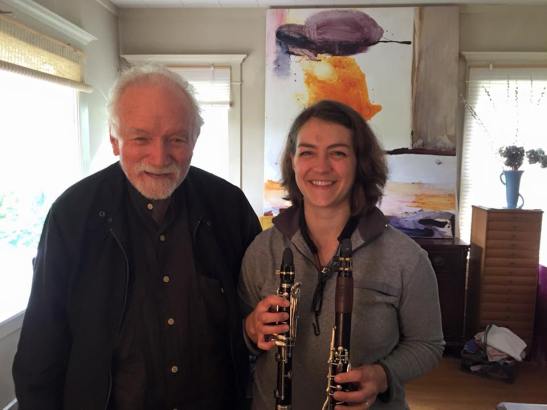
First, here’s a photo from the Austin ClarinetFest.  This is me and composer Chapman Welch, after my performance of his piece Moiré.  I’ll be playing it again as part of a solo recital at the upcoming Dallas Festival of Modern Music on November 7, which will also include a new work for clarinet and computer by Scott Price.  And the Chameleon Chamber Group is as busy as ever, with several upcoming performances in Dallas, and a new album out (more details on that later).

Meanwhile, I expect to graduate with my doctorate from the University of North Texas this December!  As of last week, I have successfully defended my dissertation on interactive music for clarinet and computer.  I hope to be able to share my research here once the dissertation is officially approved by the graduate school.  So, it’s a busy fall, but I’m excited about each of the projects I’m involved with – especially the very, very, long-term project of finishing my degree!

ClarinetFest 2010

By admin, July 6, 2010

I’m excited to announce that I will be performing at the International Clarinet Association’s ClarinetFest 2010 in Austin, Texas! I’ll be playing Chapman Welch’s Moiré for clarinet and computer, which you can hear on my Audio page.  The work was written for clarinet, computer, and optional ensemble, and incorporates extended techniques such as multiphonics, portamento, and Bismallah Khan-inspired ornamentation, improvisation, and melodic material.  The concert is at 1 PM on Thursday, July 22, in Bates Recital Hall.

Welcome to RachelYoderClarinet.com!

By admin, January 10, 2009

I have created this website as a way for me to share information about myself and my clarinet-related activities.  Enjoy!

Panorama Theme by Themocracy